Frozen Accidents : choix figés et héritages durables
Journée d’étude interdisciplinaire
Vendredi 20 novembre 2026
HiCSA, Université Paris 1 Panthéon-Sorbonne
Galerie Colbert, salle Vasari, Paris
En 1968, Francis Crick suggérait que le code génétique pouvait être un « accident figé » : le résultat contingent d’une histoire qui, une fois établi, ne pouvait plus être défait.
Mais ces accidents sont-ils réellement figés ? Peut-on les inverser ou échapper à leurs conséquences ? Certaines situations apparemment contingentes sont-elles, en définitive, inévitables ? Et les accidents figés existent-ils vraiment ?
La journée d’étude Frozen Accidents : choix figés et héritages durables réunira des biologistes, des historiens de l’art et des spécialistes de littérature pour examiner ensemble ces questions. L’idée de Crick constituera un point de départ, plutôt qu’une vérité acquise. Nous chercherons à comprendre ce qu’elle permet de penser, les limites qu’elle rencontre et ce qui se produit lorsque des disciplines différentes s’emparent d’une même interrogation.
Toutes les interventions sont conçues pour un public non spécialiste. Aucune expertise préalable dans les domaines abordés n’est nécessaire : le débat sera au cœur de cette rencontre.
Organisée par Sefy Hendler, Université Paris 1 Panthéon-Sorbonne (HiCSA), et Oded Rechavi, Tel Aviv University, cette journée est ouverte aux collègues, aux étudiants et à toute personne intéressée par ces questions.
Programme
Chaque intervention comprend une présentation de 30 minutes, suivie de 5 minutes de questions et de discussion.
9h00 / Accueil et ouverture
Sefy Hendler, Université Paris 1 Panthéon-Sorbonne (HiCSA), et Oded Rechavi, Tel Aviv University
9h15 / Sciences
Nick Lane, University College London
The original frozen accident – is it real?
9h50 / Histoire de l’art
Sefy Hendler, Université Paris 1 Panthéon-Sorbonne (HiCSA)
Not a Feature, a Bug: Ex Uno Lapide Between Ancient Myth and Renaissance Construction
10h25 / Pause-café
10h45 / Sciences
Virginie Courtier, Institut Jacques Monod, CNRS / Université Paris Cité
Frozen accidents over the course of genetic evolution
11h20 / Histoire de l’art
Guillaume Cassegrain, Université Grenoble Alpes
Débusquer les rats. L’histoire de l’art et la question animale
12h00 / Pause
13h30 / Histoire de l’art et littérature
Eran Horowitz, Université Grenoble Alpes
In a Frozen Environment There Are No Accidents
14h05 / Sciences
Martin M. Hanczyc, University of Trento
Animated Droplets
14h40 / Pause
15h00 / Histoire de l’art
Francesco Benelli, University of Bologna
Antonio da Sangallo the Younger and James T. Reason on Ancient Roman Topography
15h35 / Sciences
Oded Rechavi, Tel Aviv University
The cold never bothered me anyway
16h10 / Histoire de l’art
Carolina Mangone, Princeton University
Michelangelo’s “Non-Finito” and Rodin’s Modernity: A Frozen Historiographical Accident?
16h45 / Discussion générale
Les accidents figés existent-ils ? Si oui, peut-on les défiger ?
17h15 / Conclusion
Synthèse et remarques finales
---
Frozen Accidents: Fixed Choices and Enduring Legacies
One-day interdisciplinary conference — Friday, November 20, 2026
HiCSA research center, Université Paris 1 Panthéon-Sorbonne
Institut national d’histoire de l’art (INHA), Galerie Colbert, Salle Vasari, Paris
In 1968, Francis Crick suggested that the genetic code might be a “frozen accident”: an arbitrary outcome of historical chance that, once established, could never be undone.
But are frozen accidents really frozen? Can they be reversed, or escaped? Are some apparently contingent outcomes inevitable after all? And do frozen accidents even exist?
Frozen Accidents: Fixed Choices and Enduring Legacies brings biologists, art historians, and literary scholars together to explore these questions. We will take Crick’s idea as a starting point, not as settled truth, and ask where it helps us think, where it breaks down, and what happens when very different disciplines take on the same question.
Every talk is designed for non-specialists, so no expertise in any particular field is needed to follow the discussion. Debate is not only welcome: it is the point.
Organized by Sefy Hendler, Université Paris 1 Panthéon-Sorbonne (HiCSA), and Oded Rechavi, Tel Aviv University, the conference welcomes colleagues, students, and anyone curious about these questions.
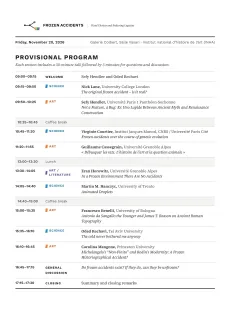
Provisional program
Each presentation consists of a 30-minute talk followed by 5 minutes for questions and discussion.
09:00–09:15 — Welcome
Sefy Hendler, Université Paris 1 Panthéon-Sorbonne (HiCSA), and Oded Rechavi, Tel Aviv University
09:15–09:50 — Science
Nick Lane, University College London
The original frozen accident – is it real?
09:50–10:25 — Art
Sefy Hendler, Université Paris 1 Panthéon-Sorbonne (HiCSA)
Not a Feature, a Bug: Ex Uno Lapide Between Ancient Myth and Renaissance Construction
10:25–10:45 — Coffee break
10:45–11:20 — Science
Virginie Courtier, Institut Jacques Monod, CNRS / Université Paris Cité
Frozen accidents over the course of genetic evolution
11:20–11:55 — Art
Guillaume Cassegrain, Université Grenoble Alpes
Débusquer les rats. L’histoire de l’art et la question animale
12:00–13:30 — Lunch
13:30–14:05 — Art / Literature
Eran Horowitz, Université Grenoble Alpes
In a Frozen Environment There Are No Accidents
14:05–14:40 — Science
Martin M. Hanczyc, University of Trento
Animated Droplets
14:40–15:00 — Coffee break
15:00–15:35 — Art
Francesco Benelli, University of Bologna
Antonio da Sangallo the Younger and James T. Reason on Ancient Roman Topography
15:35–16:10 — Science
Oded Rechavi, Tel Aviv University
The cold never bothered me anyway
16:10–16:45 — Art
Carolina Mangone, Princeton University
Michelangelo’s “Non-Finito” and Rodin’s Modernity: A Frozen Historiographical Accident?
16:45–17:15 — General discussion
Do frozen accidents exist? If they do, can they be unfrozen?
17:15–17:30 — Closing
Summary and closing remarks
Free admission subject to availability