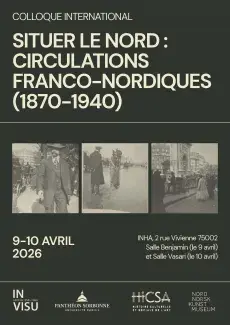
Situer le Nord : circulations franco-nordiques (1870-1940)
Colloque international
Situating the North: Franco-Nordic circulations (1870-1940)
International Conference
Organisatrices : Dina EIKELAND (doctorante, Université de Paris 1 Panthéon-Sorbonne/INHA-InVisu) et Victoria GRIGORENKO (doctorante, ENS/INHA)
Programme
9 avril 2025
Galerie Colbert, salle Benjamin
9h00 / Accueil
9h30 / Ouverture de la journée, par Dina Eikeland et Victoria Grigorenko
9h45 /
Première session : L’art français dans l’Europe du Nord : réception, circulations et controverses
modérateur : Victor Claass, Musée d’Orsay
Nicholas PARKINSON, vacataire au Département des Langues, Université Paris 1 Panthéon-Sorbonne
When Modernism Became History: Retrospective Logic and Den Franske Kunstudstilling in Copenhagen, 1888
This paper examines Den Franske Kunstudstilling (The French Art Exhibition), a collaborative Franco-Danish event organized in Copenhagen in 1888, as a formative yet overlooked site of artistic exchange and historiographic conflict. Conceived amid fin-de-siècle reflection, when retrospective exhibitions were becoming common practice in France as a means of formalizing the century's artistic canons, the exhibition sought to present a lineage from Romanticism to contemporary French painting for a Danish audience. Drawing on archival evidence and press reception, the paper argues that the exhibition exposed a fundamental tension between curatorial ambitions to institutionalize modernism and critics’ insistence on modern art’s essentially transient nature, revealing how art was negotiated, resisted, and reframed in a transnational context.
Baiba VANAGA, Exhibition Curator at the Latvian National Museum of Art (Riga)
The Exhibition of Parisian Artists in Riga in 1909/1910 and its reception
In December 1909, an exhibition of Parisian painters was opened at the Riga City Art Museum, organized by the Riga Art Society and sculptor Konstanty Rączewski. Alongside such renowned French masters as Edmond Aman-Jean, Pierre Bonnard and Édouard Vuillard, also taking part were Spaniard Hermenegildo Anglada Camarasa, Latvian-born Alice Dannenberg, and others. It was the first French art exhibition in Latvia, and it attracted the attention of the local press. This paper will introduce both the organizers of the exhibition and the organizational process, as well as its content and reception.
10h45 / Pause
11h00 / Reprise de la première session
Dina EIKELAND, doctorante, Université de Paris I/ INHA et Victoria GRIGORENKO, doctorante, ENS/ INHA
French art exhibitions in Saint Petersburg (1912) and Copenhagen (1914): Northern European circulation of an exhibition model
In 1912, the Centennial Exhibition of French Art (1812–1912) organized by the French art historian Louis Réau in Saint Petersburg became a model for the dissemination of French art in Northern Europe. Two years later, the Fransk malerikunst fra det 19nde aarhundrede in Copenhagen explicitly followed in its footsteps. This paper analyzes the ideological and organizational links between these exhibitions and studies the circulation in Northern Europe of a certain idea of the French 19th century art, in a context marked by the rise of French cultural diplomacy.
Hugo TARDY, docteur en histoire de l’art moderne, ingénieur d’études CNRS – IRCL Montpellier Paul Valery
Quelle(s) vision(s) des artistes de la Baltique chez Louis Réau ?
Louis Réau s’impose comme la figure majeure de l’historiographie des relations artistiques entre la France et la Russie. Dans son livre, L’Art russe, il pose la question fondatrice : « Existe-t-il un art national russe ? », une interrogation qui excède le champ esthétique pour s’inscrire dans une réflexion politique. Cette idée trouve un prolongement dans son Histoire de l’expansion de l’art français, notamment dans le volume sur les pays scandinaves et baltes, où les artistes évoqués sont là pour étayer l’idée d’une hégémonie française autour de la Baltique.
12h00 / Pause
13h30 /
Deuxième session : Exposer l’extrême nord : entre enjeux ethnographiques et imaginaires climatiques
modératrice : Christine Laurière, CNRS
Anatole DANTO, chercheur au centre de recherches Europe-Eurasie, INALCO, Paris/ Arctic studies center, l’Université de Tartu, Estonie et Katarina Wadstein MACLEOD, professeure d’Histoire de l’art, Département de culture et d’esthétique à l’Université de Stockholm
Exhibiting the Arctic in Paris: Multi-representations of Northern Nature
This paper examines how Arctic nature and life were constructed through art exhibitions in Paris between 1905 and 1940. The painted artworks by the Swedish Anna Boberg and the French René-Yves Creston are analyzed and also the mediation of their art from the perspectives of art history and anthropology. It demonstrates how their work presents a complex desire for the North and how this developed across the first decades of the 20th century. Their examples show how the networks amongst artists, dealers and the Navy but also scientific or media institutions helped circulate ideas of “borealism”.
Solveig VANNIEZ-SALVESEN, PhD researcher in History at the European University Institute in Florence
Exhibiting the Circumpolar North: Curatorial Practices and the reception of Sámi Art in 1930’s Paris
Exhibitions of Indigenous art objects and artists in 1930’s Paris occupied an ambivalent position within a period marked by independent galleries, international congresses, and colonial exhibitions. This presentation examines the exhibition and reception of Arctic Indigenous art objects in Paris during this period. It considers the dynamics between ethnographic display, artistic recognition, and colonial representation, and further questions how these underlying narratives fed into the later development of ‘indigenous art’ as a category.
14h30 / Pause
14h45 / Table ronde
Franco-Nordic exchanges through the lens of recent exhibitions. Debates surrounding a trend.
In recent years, major exhibitions of Nordic art have multiplied in Paris, as well as in the United States, the United Kingdom and Switzerland. Bringing together curators from Nordic institutions and Parisian museums, this roundtable asks why this renewed international interest has emerged and how these exhibitions relate to current research developed in the Nordic countries. It examines how narratives are shaped for largely unfamiliar audiences, and whether they reproduce or challenge a Paris-centred canon of art history.
Participant·e·s :
Christine TOMMERUP (modératrice), conservatrice art français et danois du XIXe et XXe siècle, Ny Carlsberg Glyptotek Copenhague.
Stina HÖGKVIST, directrice Nordnorsk Kunstmuseum Tromsø et ancienne cheffe des collections au Nasjonalmuseet, Oslo.
Laura GUTMAN, conservatrice, Musées du Second Empire et de l’Impératrice.
Pascal Rousseau, professeur, Université Paris I Panthéon-Sorbonne.
Servane Dargnies, conservatrice en chef peinture, Musée d’Orsay.
16h15 / Clôture de la première journée
10 avril 2025
Galerie Colbert, salle Vasari
9h30 / Accueil
10h00 /
Troisième session : Les circulations franco-nordiques dans l’histoire transnationale du théâtre et du cinéma
modératrice : Valérie Pozner
Julie K. ALLEN, professor of Comparative Arts and Letters, Brigham Young University in Provo, Utah
Sarah and Asta in Paris: Franco-Nordic Silent Cinema Ties
This paper explores the theatrical and cinematic connections between iconic French actress Sarah Bernardt (1844-1923) and the Danish silent film diva Asta Nielsen (1881-1972), often called “the Bernhard of the North”. Drawing on contemporary newspaper coverage, personal narrarives, visual media, including photographs, advertisements, and film footage, this paper demonstrates how both women functioned as iconic symbols of their respective national film industries in early cinema and influential agents in networks of Franco-Nordic cultural exchange.
Madeleine RIOUSSE, Doctorante contractuelle à l’EHESS rattachée au Centre de Recherches Historiques (CRH)
Circulations transnationales en Lituanie dans l’entre-deux-guerres : le cas Mekas
Cette communication propose d’explorer les circulations artistiques en Lituanie pendant l’entre-deux-guerres à travers Jonas Mekas. En montrant comment des espaces apparemment périphériques peuvent devenir de véritables nœuds culturels où se croisent diverses dynamiques, cette présentation s’attachera tout d’abord à dresser un contexte national lituanien ; elle examinera ensuite la petite ville provinciale où Mekas grandit et la manière dont il s’imprègne de ces influences, notamment à travers l’étude de la création d’un théâtre local dans lequel il s’investit et de son directeur, formé à Paris, révélant le rôle structurant d’espaces a priori marginaux dans sa trajectoire artistique et intellectuelle.
11h00 / Pause
11h15 /
Quatrième session : Le franco-nordique et au-delà : pour une cartographie des trajectoires transnationales d’artistes nord-européens
modératrice : Linda Hinners conservatrice Nationalmuseum, Stockholm
Cyrielle DUROX, Responsable des collections de photographies, musée Rodin
Sculpteur et diplomate franco-russe : Serge Youriévitch (1876-1969)
De parents russes mais né en France Serge Youriévitch (1876-1969) fait ses études aux côtés de la noblesse à Saint-Pétersbourg et les termine à l’École des sciences politiques à Paris. Il débute une carrière de diplomate qu’il combine ensuite avec celle de sculpteur, les mettant avantageusement au service l’une de l’autre. Sa statue la plus connue est celle de la danseuse russe Natacha Nattova. Son réseau de relations et ses voyages, en la France, la Russie et ses pays alliés de l’époque, se révèlent au travers d’un fond de photographies conservé au musée Rodin.
Ariane SERCK, doctorante, EHESS/INHA/FARMO
Transnational Circulations and Textile Slöjd in Swedish Schooling Around 1900
The present study examines the social, aesthetic and political issues surrounding the introduction of textile slöjd in Swedish schools in the late 19th century, both nationally and internationally. Through a comparative analysis of exchanges between different countries, such as Swedish educator Hulda Lundin's trips to Germany in 1881 and France in 1887, and her collaboration with Otto Salomon at the 1893 Chicago World's Fair, the study seeks to understand both the circulation of actors and ideas, but also the specificities of the Swedish model of slöjd teaching in schools.
12h15 / Pause
14h00 / Reprise de la quatrième session
Vibeke RÖSTORP, docteure en histoire de l’art et chercheuse indépendante
Un regard transnational sur l’artiste Ludvig Karsten
Cette communication propose une réévaluation de l’artiste norvégien Ludvig Karsten (1876-1925) à travers l’étude de ses circulations entre la Scandinavie et la France. En se concentrant sur sa période parisienne (1900-1912), l’analyse met en lumière son intégration à l’avant-garde, ses liens avec Carrière, Picasso et Matisse, et souligne l’importance de son parcours transnational pour comprendre sa place dans l’histoire de l’art norvégien.
Emmanuelle GRASSET, doctorante contractuelle à l’Université de Tours, membre du laboratoire CeTHiS – Centre Tourangeau d’Histoire et d’étude des Sources
La Maison Watteau, le centre culturel des Suédois de Paris au début du XXe siècle
À partir de 1919, la diaspora suédoise installée à Paris se réunit à la Maison Watteau, dans le quartier de Montparnasse. Lieu central des sociabilités artistiques dirigé par la sculptrice Lena Börjeson (1879-1976), sa mission première est d’exposer et de vendre les artistes nordiques résidant en France. Progressivement, le panel s’internationalise et la Maison se double en 1926 d’une école de peinture et de sculpture, l’Académie Scandinave. Les dix premières années sont un immense succès et fabriquent un centre clé de la diffusion de l’art suédois à l’étranger, quoiqu’aujourd’hui méconnu.
15h30 / Clôture de la journée